This is an HTML version, with new photos and updates (shown in blue), of the original article published in Diecast Collector April 1999.
Put your mouse over a thumbnail image to see the photo caption, and click to enlarge.
Matchbox Toys from Down Under
Tucker Box, Lincoln Matchbox, Motorway Mini and Hong Kong series
Like so many
successful ideas, Lesney's Matchbox Series quickly had imitators, both
in the UK and around the world. Many manufacturers copied the idea of a
series of miniature models with a novelty box - the Morestone ''Esso''
series and Benbros ''TV Series'' are two well-known examples.
Some manufacturers went further and copied Matchbox designs, both in
metal and plastic. There are so many that collecting Matchbox
copies can be a theme in its own right. The most shameless
imitators used the Matchbox name on their own toys. This sort of
copying was less common because it would be relatively easy to prove
infringement of the Matchbox trade mark in the courts.
Examples of all three types of copying occurred in a series of die-cast miniatures which started in Australia, then moved to New Zealand, and later to Hong Kong. Tucker
Box Series
 The
series originated as the Tucker Box Series, which was
made in Australia, and consisted of seven models. They were
packed in
red and yellow boxes with TUCKER BOX SERIES MINIATURE MODELS above a
picture, which (our Australian correspondent tells us) is of the famous
statue of a dog
on a tuckerbox at Gundagai, NSW (between Melbourne and
Sydney). The distributor was Alex Tolmer and Associates Pty. Ltd.
of Melbourne, and their name appeared on the sides of the boxes.
Alex Tolmer was also the distributor of the Micro Models range of Dinky
size models. In his book on Micro Models, David Daw reproduces
several trade advertisements by Alex Tolmer, and the style of lettering
used for the company name on the Tucker Box boxes appears in 1958
adverts but had not been introduced in 1956. This would seem to date
the Tucker Box Series to around 1957. The
series originated as the Tucker Box Series, which was
made in Australia, and consisted of seven models. They were
packed in
red and yellow boxes with TUCKER BOX SERIES MINIATURE MODELS above a
picture, which (our Australian correspondent tells us) is of the famous
statue of a dog
on a tuckerbox at Gundagai, NSW (between Melbourne and
Sydney). The distributor was Alex Tolmer and Associates Pty. Ltd.
of Melbourne, and their name appeared on the sides of the boxes.
Alex Tolmer was also the distributor of the Micro Models range of Dinky
size models. In his book on Micro Models, David Daw reproduces
several trade advertisements by Alex Tolmer, and the style of lettering
used for the company name on the Tucker Box boxes appears in 1958
adverts but had not been introduced in 1956. This would seem to date
the Tucker Box Series to around 1957.The end flaps of the boxes had the name of the model printed, together with a line drawing. The models were one-piece castings with either metal or black plastic wheels and crimped axles. No name or identification was cast on any of them.  Austin Petrol Tanker Austin Petrol TankerLength 56mm. A normal control tanker with a divided windscreen and four tank compartments behind.  Fire Engine Fire EngineLength 51mm. This open fire engine had a separate detachable ladder.   Sand
Truck Sand
TruckLength 56mm. This was actually a pick-up truck (or ''utility'') with an unusually wide rear load area. 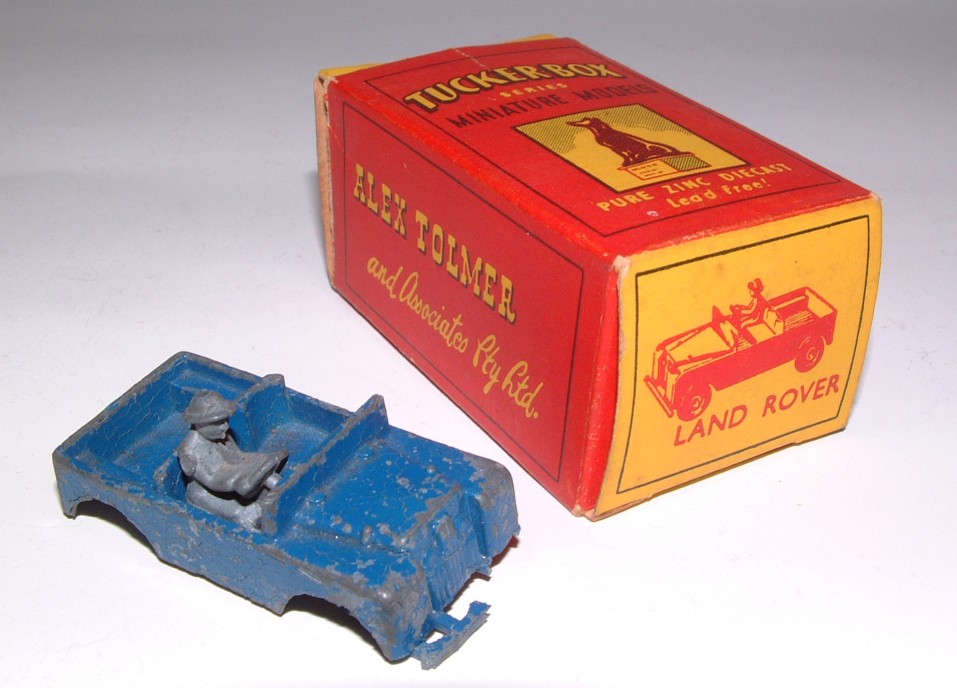 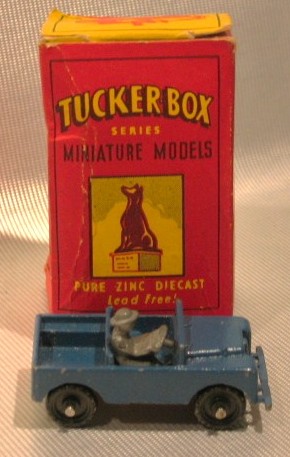    Land Rover Length 45mm (first casting), 43mm (second casting). This was similar to the first Matchbox Land Rover (no.12). There were two completely different dies used for this model and its driver. The first casting had black plastic wheels and curved seat backs; the second casting had metal wheels and was narrower overall but had bonnet hinges wider apart, straight seat backs and a thinner driver. Also note the two different sizes of box shown in the photos.   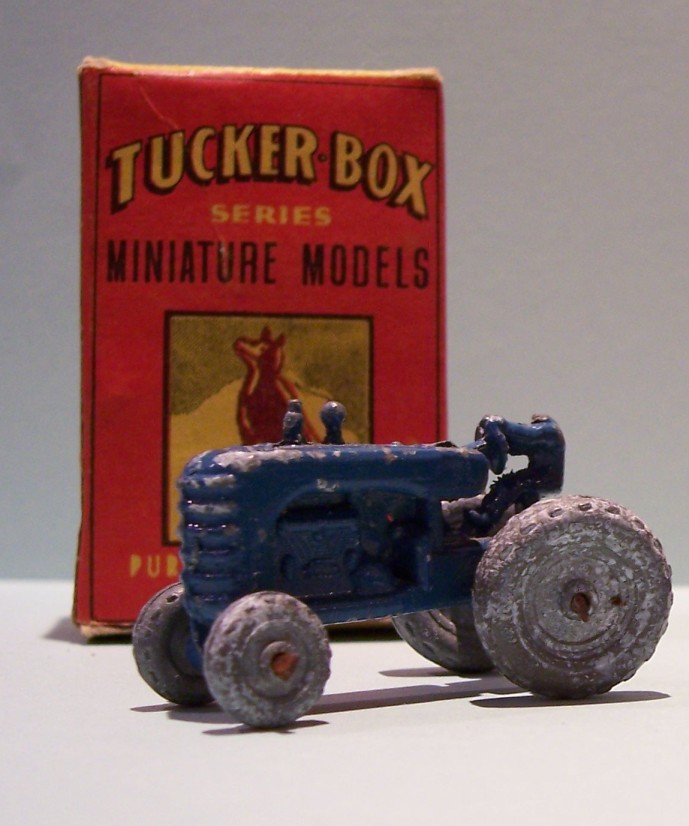 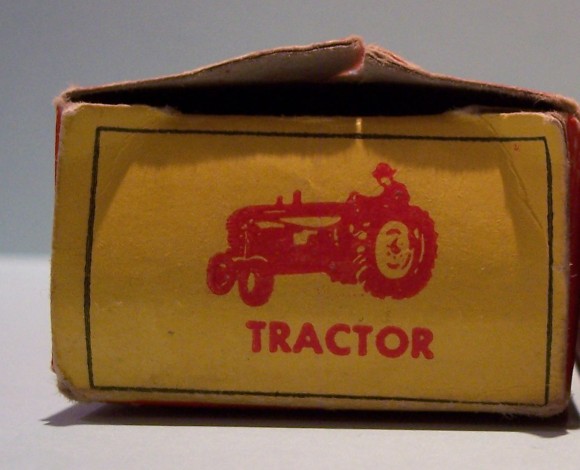 Massey Harris Tractor Length 41mm. Very similar to Lesney's Matchbox model (no.4). The driver was cast in with the model. Again there were two different castings, the first having rear mudguards and black plastic wheels, while the second had no mudguards and metal wheels. Again there were two different box sizes. 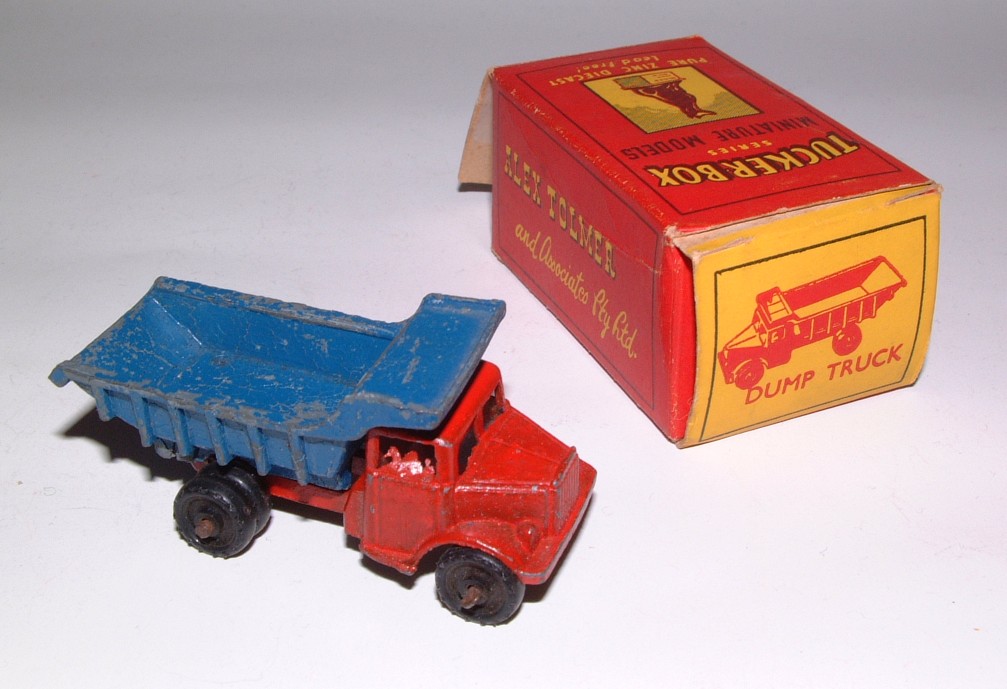 Dump
Truck Dump
TruckLength 56mm. Very similar to the first Lesney Matchbox no.6. There may have been two different Tucker Box versions of this model as well. The model pictured has black plastic wheels and was not re-issued in the Lincoln Matchbox series (see below). The Lincoln Matchbox Dump Truck was a new casting, but of course it may have started life in the Tucker Box series, however I have not seen an example in a Tucker Box box. 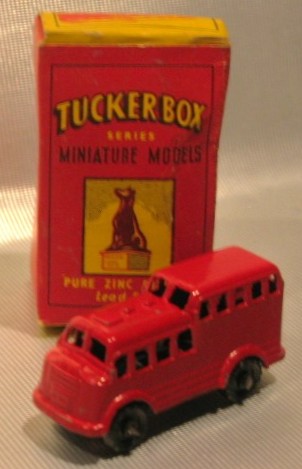  11/2
deck Bus 11/2
deck BusAt first sight this bus looks like the Streamlux/Fun Ho! model, but on closer examination it is from a different die. The Streamlux version has an extra window on the lower deck on each side and there are other differences too. Black plastic wheels were fitted to the Tucker Box model. Lincoln
Matchbox Series
  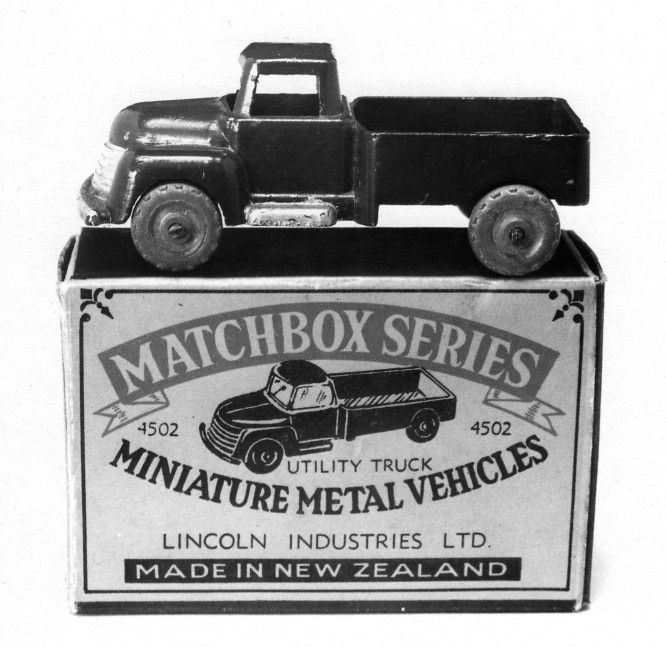 The dies for five of the Tucker Box range - the Tanker, Fire Engine, Sand Truck, Land Rover (second type) and Tractor (second type) - seem to have been acquired by Lincoln Industries Ltd. of Auckland, New Zealand. Lincoln were already producing the Micro Models series in New Zealand, using dies loaned from Australia. New Zealand's import restrictions on toys meant that it was essential for toy production to be carried out locally.    The Tucker Box dies for the Land Rover (first type) and Dump Truck (first type) were not used by Lincoln, but these dies also went to New Zealand and were issued as part of the Fun Ho! Midget series from 1966. The Land Rover was Fun Ho! no.19 and the Dump Truck no.31. The Fun Ho! Land Rover can be identified by the addition of a tow hook, and later examples had FUN HO No19 LAND ROVER MADE IN NEW ZEALAND cast underneath. The Dump Truck had FUN HO and other lettering cast under the tipping body. The Tucker Box dies for the Tractor (first type) and Bus were not re-issued, as far as is known. Lincoln did produce a Dump Truck from a new die, and introduced six further new models resulting in a series of twelve.  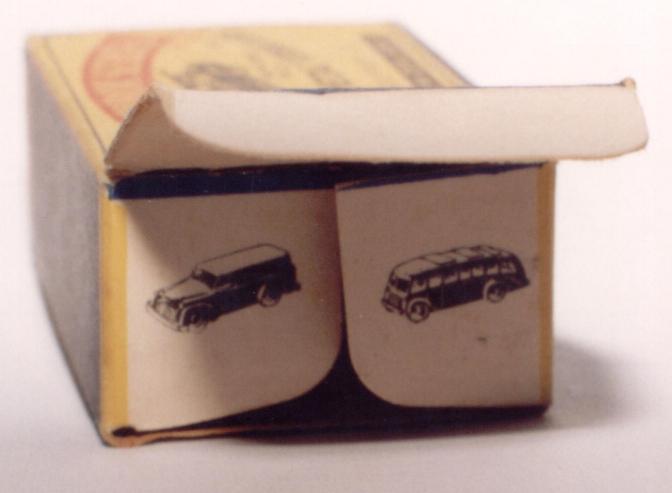 They were
packed in Matchbox-style boxes with MATCHBOX SERIES in a red scroll on
the face. Under this in black was a line drawing of the model
with the model number on either side and the model name. Under
the illustration was MINIATURE METAL VEHICLES and at the bottom
LINCOLN INDUSTRIES LTD. and MADE IN NEW ZEALAND. Clearly Lincoln
were not shy about their abuse of the Matchbox trade mark!
Other models in the series were shown on the inside end flaps. They were
packed in Matchbox-style boxes with MATCHBOX SERIES in a red scroll on
the face. Under this in black was a line drawing of the model
with the model number on either side and the model name. Under
the illustration was MINIATURE METAL VEHICLES and at the bottom
LINCOLN INDUSTRIES LTD. and MADE IN NEW ZEALAND. Clearly Lincoln
were not shy about their abuse of the Matchbox trade mark!
Other models in the series were shown on the inside end flaps.The model numbers were in the 4500 range and those that I have been able to confirm are listed in the table at the end of the article. Only the Dump Truck number is still unconfirmed, presumably 4511, so if you have a box for this item, please e-mail me a photo. The Lincoln Fire Engine had a shorter and wider ladder, with fewer rungs, and plastic wheels did not seem to occur on the New Zealand models. I am not aware of any other differences between the Lincoln Matchbox versions and the earlier Tucker Box models. The Lincoln Matchbox Series appeared around 1958. The new castings in addition to the five ex-Tucker Box items were as follows.  Dump
Truck Dump
TruckLength 51mm. The Lincoln Dump Truck was narrower than the Tucker Box and the dump body had ribs on the cab overhang; headlights on the Tucker Box were next to the radiator, but on the Lincoln were positioned on the wings. Also the Tucker Box Dump Truck had dual rear wheels but the Lincoln had single wheels.. 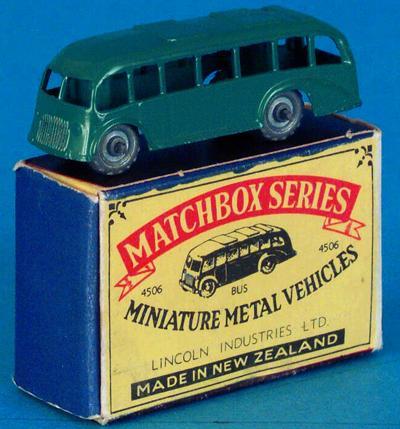 ''Land
Liner'' Coach ''Land
Liner'' CoachLength 57mm. Similar in shape to Lesney Matchbox no.21, but with a simpler grille of vertical bars and no baseplate. 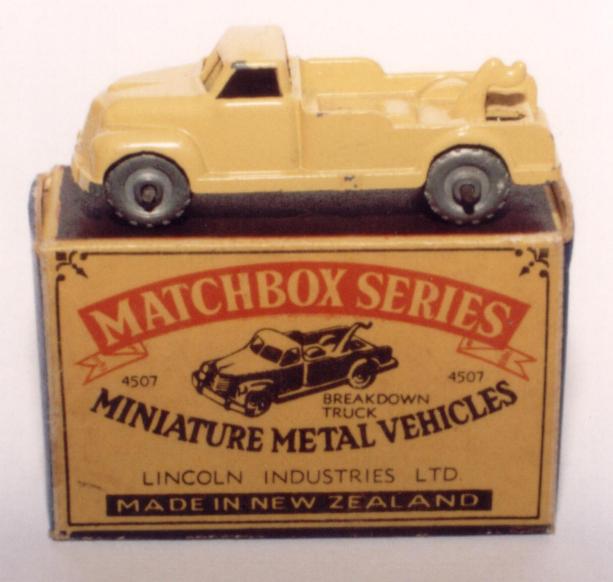 Breakdown
Truck Breakdown
TruckLength 54mm. A normal control truck with a divided screen and simple hook cast on to the rear flat bed. 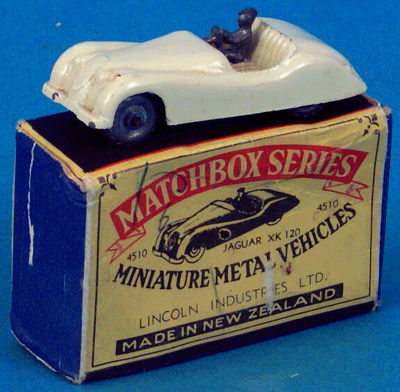 Jaguar
XK120 Roadster Jaguar
XK120 RoadsterLength 54mm. This had a separately cast driver fitted to a hole in the seat.  Racing Car Racing CarLength 50mm. I am not sure what vehicle this was meant to represent. Again there was a hole in the seat for a driver.  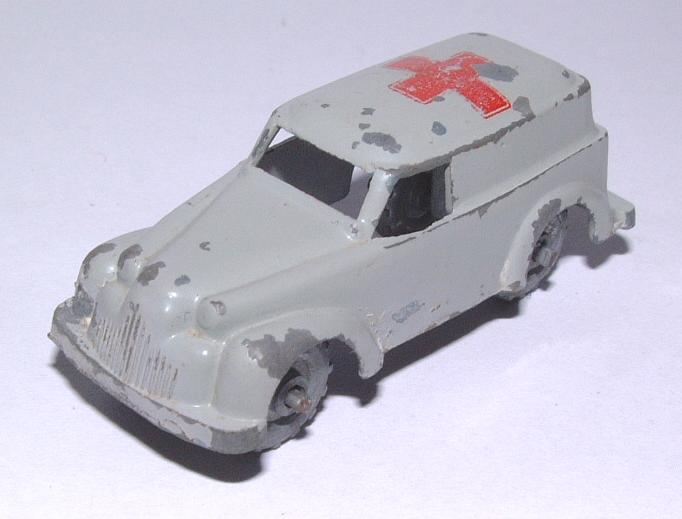 Ambulance AmbulanceLength 49mm. This was actually a light van with a red cross printed on the roof. 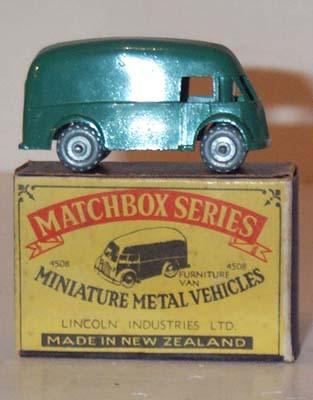  Pantechnicon PantechniconLength 52mm. Another original design, reminiscent of a Morris J type but with a high roof body. The outline of double doors was cast at the rear. Motorway Mini Series 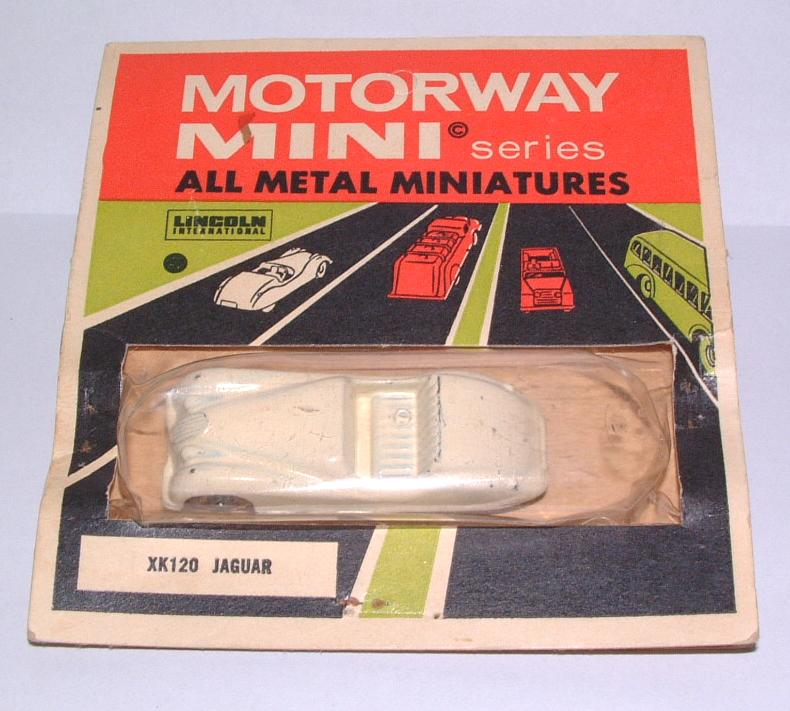  The
Lincoln Matchbox Series did not last long, possibly
because of legal action or the threat of action by Lesney.
Lincoln had to stop using the Matchbox name, but the similarity of some
of the models to Lesney's own production did not seem to stop them
being reissued under a different brand name. Lincoln's new brand
was the Motorway Mini Series. The twelve models were bubble
packed, and the backing card showed a motorway scene with the Jaguar,
petrol tanker, Land Rover and coach. The
Lincoln Matchbox Series did not last long, possibly
because of legal action or the threat of action by Lesney.
Lincoln had to stop using the Matchbox name, but the similarity of some
of the models to Lesney's own production did not seem to stop them
being reissued under a different brand name. Lincoln's new brand
was the Motorway Mini Series. The twelve models were bubble
packed, and the backing card showed a motorway scene with the Jaguar,
petrol tanker, Land Rover and coach. The
packaging was much more
up-to-date and 1960s in style compared with the old Matchbox
boxes. The model name was printed in the bottom left hand corner
of the card, and the full range was listed on the reverse, numbered
from 4300 to 4311. Curiously, these numbers had been used
previously for some of the Lincoln Micro Models, which were
discontinued around 1960. This tends to suggest that the Motorway
Mini Series dates from the early 1960s. Steve Brown kindly supplied this
photo of a "Mini Model Fleet" shrink-wrapped gift set of Motorway Mini
models. The
packaging was much more
up-to-date and 1960s in style compared with the old Matchbox
boxes. The model name was printed in the bottom left hand corner
of the card, and the full range was listed on the reverse, numbered
from 4300 to 4311. Curiously, these numbers had been used
previously for some of the Lincoln Micro Models, which were
discontinued around 1960. This tends to suggest that the Motorway
Mini Series dates from the early 1960s. Steve Brown kindly supplied this
photo of a "Mini Model Fleet" shrink-wrapped gift set of Motorway Mini
models.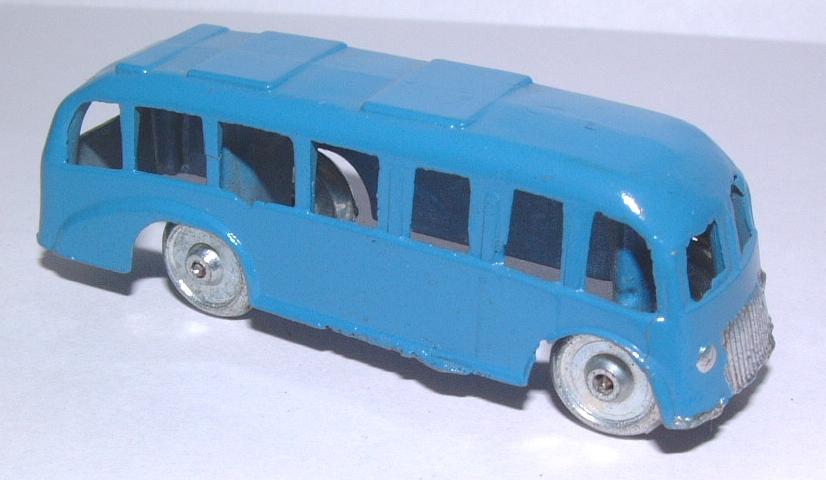      Compared with the Matchbox Series, there were some minor changes. The Jaguar XK120 lost its driver, and on my example the hole in the seat is filled with flash. The Land Rover and Racing Car can be found with or without a driver. The Ambulance lost its red cross and simply became a van (called ''Pick-Up-Van'' on the packaging). Steve Brown has pointed out that the wheels and axles were changed, so that the wheels were a push-fit, eliminating the earlier crimped axle ends, and some models (such as the coach pictured here) had smooth wheels without treads. Hong Kong Series
The
Motorway Mini packaging also included the name Lincoln
International, reflecting the expansion of Lincoln Industries into Hong
Kong. The dies for the miniature series accordingly were sent to
Lincoln's Hong Kong operation, and all the models had MADE IN HONG KONG
added to the casting. The Hong Kong series appeared around 1966.
             I am not sure how the Hong Kong models were packaged - probably they were bagged or sold from counter packs, because the packaging does not seem to survive. Hong Kong models are quite often found with mask sprayed two-tone colours; the tanker in dark blue and cream and the dump truck in dark green, yellow and red illustrated here are two attractive examples. Drivers were reinstated for Hong Kong production, which together with the two-tone colours shows a clear effort to make the most of the range rather than cut costs. Also there was a return to crimped axle ends rather than push-fit wheels. The light van was again produced as an Ambulance. The Hong Kong series was exported to the UK, and these are the models most likely to be found at UK swapmeets. Models made in Australia and New Zealand were not sold here and are much harder to find for UK collectors. The models do not command any great value, but they make a charming little series which could never hope to live up to the Lesney Matchbox toys that they copied. Table of Models
Notes: The Pick-up Truck was
called ''Sand Truck'' in the Tucker Box Series.
The light van was called ''Pick-Up-Van'' in the Motorway Mini Series, and in the Matchbox Series and Hong Kong series was an Ambulance, with a red cross on the roof. The pantechnicon was called ''Furniture Van'' in the Matchbox Series and Motorway Mini Series. If any reader can confirm the existence of those models with a question mark against them, please e-mail me. Acknowledgements Many thanks to Ron Ford, Steve Brown, ARG Hawke and Pier Van Netten, who provided several photographs and other information. References Pier van Netten - 'Australia - The Lesser Known Toys' in Modellers' World, vol.10 no.2, January 1981. David Daw - 'Micro Models A Collectors' Guide' published by the author, 1994. Steve Brown - 'Matchbox Series Miniature Metal Vehicles Made in New Zealand' in M.I.C.A.(Matchbox International Collectors' Association) magazine, June/July 2004. |


© Robert Newson